
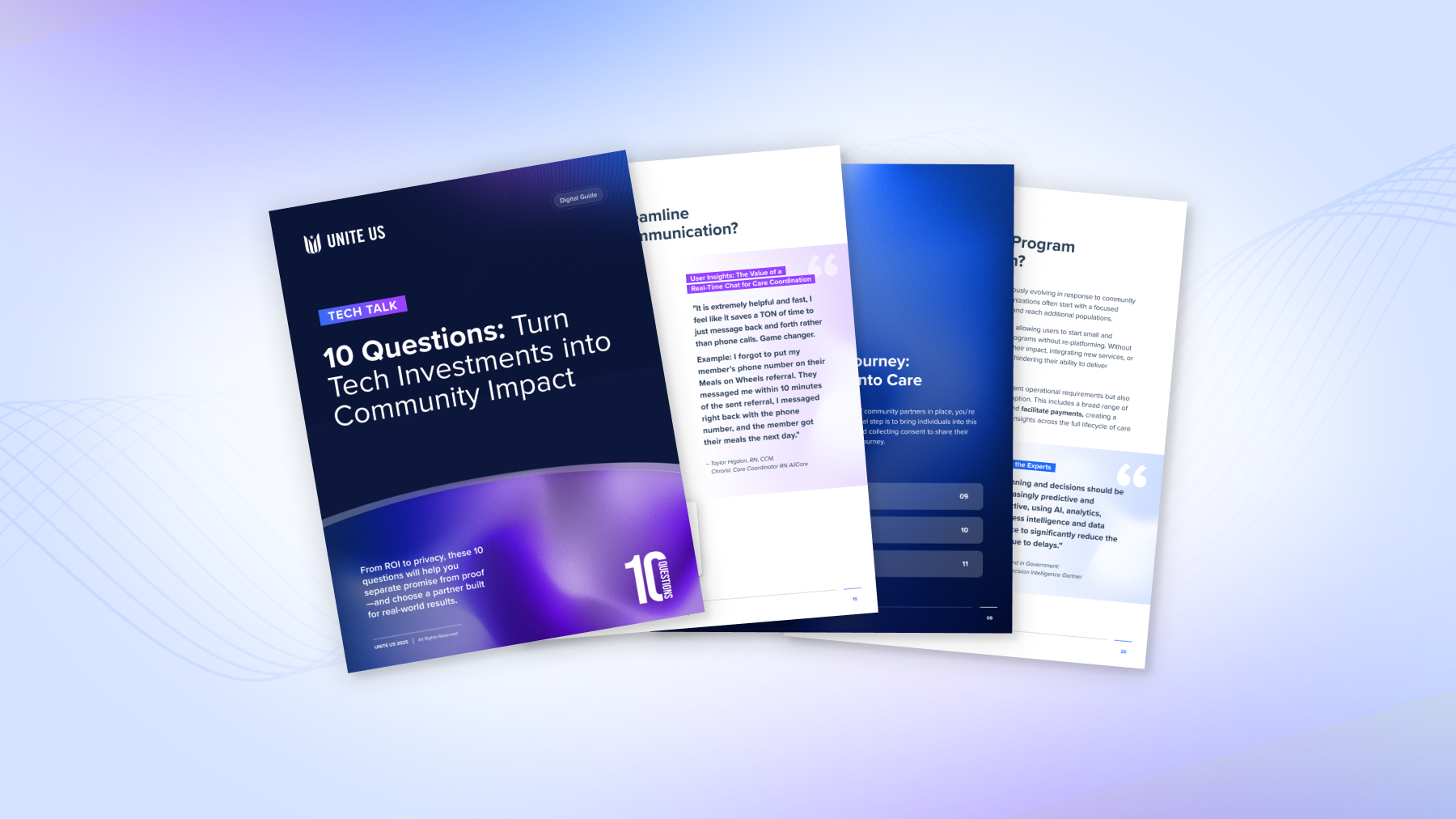
10 Questions: Turn Tech Investments into Community Impact
Selecting a technology partner is about more than features. It’s about impact you can prove. This guide breaks down 10 critical questions to ask when choosing an infrastructure partner across health and community care. It’s designed to help you cut through the noise to select a platform that predicts needs, closes the referral loop, powers reimbursements, and proves ROI—so you can invest with confidence and scale real impact.

Key Takeaways
This guide will help you:

Prove measurable impact and ROI

Predict and plan smarter

Gain confidence in your investment

Build future-ready programs

Turn efficiency into sustainability
Introduction
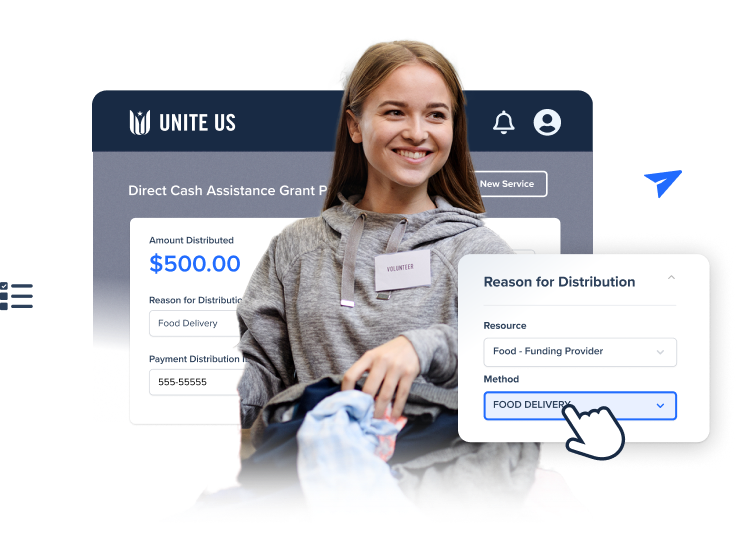 Selecting the right technology partner to support your community’s health and economic initiatives isn’t easy. It’s not just about finding the right solution, but partnering with a proven vendor who understands the complexities and nuances of effective, integrated service coordination. This guide is designed to help you navigate this journey with confidence, giving you peace of mind that the solution you choose:
- Drives Real ROI: Demonstrates proven experience to show how your investment in the technology can yield measurable returns, both in terms of cost savings and improved outcomes.
- Makes It Easier to Do Your Job: Simplifies your daily tasks and workflows, allowing you to focus more on providing care and less on administrative burdens.
- Aligns with Your Mission: Supports and enhances your organization’s mission and values, integrating the technology as a true extension of your goals.
- Avoids Costly Mistakes: Minimizes the risk of errors and inefficiencies that can lead to wasted resources and gaps in care.
- Makes a Difference For Those You Serve: Improves the quality of life for the individuals and communities you support by helping connect individuals to the right care at the right time.
Start with the End in Mind:
Demonstrating Your Impact
When evaluating any major investment, the first question is always about the return. Before diving into features and workflows, it’s critical to define what success looks like and understand how a potential partner can help you measure and demonstrate your impact.

How Do You Demonstrate Return On Investment (ROI)?
A partner with demonstrated success stories and ROI provides the foundation of trust and expertise you need to translate your investment into measurable, lasting impact. Partners who can tangibly demonstrate these proof points will help you feel more confident about how you can drive ROI and scale your impact.
What Does Measurable ROI Look Like?
$1,000+ in annual Medicaid savings per member from North Carolina’s Healthy Opportunities Pilot (HOP).
$800+ saved per patient per year by Virginia-based Ballad Health System.
$21M projected savings for the State of Ohio over the next decade from Summit County’s Benefit Bridge program (NEXT).
What to look for: A strong ROI framework makes it easier to understand the impact of where your dollars are going, while simultaneously helping you shape more effective programs, optimize resources, and facilitate more sustainable funding. This framework should consist of:
- Comprehensive data reporting and analysis to track relevant KPIs, such as service utilization, client outcomes, and resource allocation
- Verifiable examples of ROI and real-world impact, including success stories and data points that demonstrate savings
- Multiple sources of external third-party validation to verify the vendor’s claims through academic or peer-reviewed evaluation
- A dedicated Research and Evaluation team with a proven methodology for evaluating outcomes and ROI
Build the Foundation:
Strategy and Network
Demonstrating a clear ROI is the goal. But achieving that ROI requires a data informed strategy and a reliable network of partners. A powerful platform should report on what happened yesterday and help you anticipate tomorrow’s needs—all while verifying that the resources in place to meet those needs are active, engaged, and accountable.

How Do You Help Strategize and Predict; Not Just Report?
Descriptive dashboards and retrospective reports help you measure performance and outcomes, but they are not enough. To drive real impact, you need a solution that goes beyond telling you what has happened and instead helps you anticipate what might happen so you can design proactive programs. Predictive intelligence gives you a holistic, forward-looking view of the challenges facing your teams and communities—allowing you to evaluate interventions, forecast needs, and pinpoint opportunities for greater impact.
 What to look for: While descriptive data reports are common in this space, competitive tools also offer a framework designed to predict, identify, and address population health needs. Predictive insights allow you to engage the right people at the right time, close gaps in care, and deploy resources where they can have the greatest effect. These tools:
- Harness predictive models that create personalized and community level insights to enable targeted strategies for program design and outreach campaigns
- Use dynamic scoring to understand intervention impact and better health outcomes
- Close gaps in care by identifying, prioritizing, and engaging members with precision and purpose.

How Do You Validate Network Resources?
Successful community networks are built on equal parts technology and trust. To effectively connect people with care, network partners must be validated for accurate, verifiable information. This process confirms that organizations are fully operational, their information is current, and they have the capacity to accept referrals. Using advanced technologies, such as Artificial Intelligence (AI), to validate the accuracy of information reduces errors and dead-ends to build trust between network partners.
What to look for: Solutions that leverage the use of AI to maintain and validate accuracy of information available for organizations and services..
- Facilitates CBO accountability through relationship building and formal agreements
- Uses AI and other advanced tools to efficiently validate services, programs, and organizational accuracy of network members

What Does it Look Like Without Network Accountability?
“[The signs to look for] include outdated contact information, inactive listings, and a lack of real-time updates. Additionally, check if the organizations listed are actively using the platform and if there are agreements in place to ensure their participation and accountability. If the directory lacks these elements, it may be a static, unreliable resource that can lead to dead ends for clients.”
– Former user of another tool
Download the full guide
Explore all 10 questions and see what it really takes to turn infrastructure into impact.
About Unite Us
Unite Us is the nation’s leading software company bringing sectors together to improve the health and well-being of communities. We drive the collaboration to identify, deliver, and pay for services that impact whole-person health. Through Unite Us’ national network and software, community-based organizations, government agencies, and healthcare organizations are all connected to better collaborate to meet the needs of the individuals in their communities.