
Building to a $43.7M ROI: How Coordinated Care Strengthened Employment Outcomes in Summit County
In May 2025, Unite Us and the Summit County Department of Job and Family Services (DJFS) released a case study showing that Unite Us’ partnership with the NEXT program improved collaboration and increased program efficiency, with initial findings of:
- $21M projected ROI over 10 years;
- 88% of end users reporting improved program capacity; and
- 591 administrative hours saved.
Those findings established the operational value of coordinated care. This follow-up evaluation examines whether that operational progress translated into measurable outcomes for participants, and finds that it did.
Key Takeaways
 Participants whose services were coordinated through Unite Us showed greater progress on Summit County’s assessment of economic independence, created more than twice as many participant goals, and reached those goals an average of 23 days faster than participants who weren’t connected through the platform.
These participants also entered the program facing greater barriers, yet achieved stronger gains over time, proving that coordinated service delivery can strengthen participant engagement and support long-term economic stability.
With direct access to Summit County’s program data, Unite Us’ Research & Evaluation team evaluation found that the NEXT program’s projected public-sector savings are more than double initial estimates: $43.7M over 10 years, up from the original $21M projection.
Key Figures
projected public-sector savings over 10 years, across 425 program exits
more goals created by participants connected through Unite Us
faster goal achievement for Unite Us-facilitated participants
Background
 Summit County, Ohio’s Benefit Bridge program, known as NEXT, is a workforce development initiative run by DJFS. The program helps Summit County working families build their earning power over time toward economic self-sufficiency and reduced reliance on public benefits. Wraparound employment support is provided during this 18 month program, with a focus on financial wellness education, consistent case management support, financial incentives for goal attainment (e.g. job training completion or education goals achieved) and connection to community-based organizations for services like childcare and car repairs that remove barriers to employment.
The 2025 case study found that using Unite Us for care coordination improved cross-sector collaboration, streamlined program administration, and reduced administrative burden, with a projected $21M in public-sector savings over 10 years, a significant return on its own. What that evaluation didn’t yet establish was whether those operational gains showed up in participants’ lives, or how they translated into public-sector savings beyond the initial projection.
Challenges
Summit County’s DJFS caseworkers coordinate a wide range of services for NEXT participants, from job training and financial coaching to childcare and transportation support. Before Unite Us, that coordination happened largely through spreadsheets, email, and phone calls, with no shared system for tracking whether a referral led to a completed service.
That gap made it hard to answer three questions county leaders cared about:
- Do operational and efficiency gains translate into better participant outcomes?
- How do improvements in employment and reduced reliance on public benefits translate into savings for public systems?
- Do NEXT participants experience sustained economic stability over time?
This follow-up evaluation set out to answer those questions directly, using Summit County’s own participant data.
 Measuring the Impact of Coordinated Care
Summit County evaluates participant progress using a multidimensional assessment that measures economic stability across domains including employment, financial management, transportation, education, family stability, and social support. NEXT participants complete this assessment at entry, exit, and every six months while enrolled.
To understand the role coordination played, this case study compares outcomes for participants whose services were coordinated through Unite Us against participants who weren’t connected through the platform (prior to Summit County’s adoption of Unite Us).
Impact
Greater Participant Progress
Participants coordinated through Unite Us increased their Benefit Bridge scores by over 3 points on average (3.4), almost 2 more points (1.7) more than those not coordinated through Unite Us, equivalent to building an additional month of household savings.
Participants coordinated through Unite Us had even entered slightly lower assessment results, on average, meaning they faced greater challenges at enrollment. Despite that, they showed greater improvement over the course of the program and exited with higher average results.
- Entry assessment results: 69.4 (Unite Us) vs. 69.9 (non-Unite Us)
- Exit assessment results: 72.8 (Unite Us) vs. 71.6 (non-Unite Us)
- Gains accelerated the longer participants stayed engaged: +3.1 at 6 months, +4.7 (comparable to attaining an additional education level) at 12 months, and +8.6 (comparable to building 3+ months of emergency savings) at 18 months, compared to smaller gains among participants without Unite Us cases
Change in Total Bridge Score Since Entry by Having a Unite Us Case
Unite Us Case
No Unite Us Case
10.0
8.0
6.0
4.0
2.0
−2.0
0.0
3.1
0.8
4.7
2.5
8.6
−0.5
6 months
12 months
18 months
Key finding: Participants connected through Unite Us showed greater measured progress despite starting with greater barriers.
Proportion of NEXT Participants Employed at Entry and at Exit by Unite Us Case Status (N = 425)
Overall (N = 425)
UU Case (N = 296)
No UU Case (N = 129)
100%
75%
50%
25%
57%
86%
0%
64%
41%
89%
78%
Entry
Exit
Stronger Program Engagement
Whole-person workforce development depends on participants staying engaged. Participants whose services were coordinated through Unite Us:
- Created more than twice as many participant goals
- Achieved those goals 23 days faster, on average, than participants who weren’t connected through the platform
Shared visibility across providers and closed-loop referrals helped participants engage more consistently with services and make steady progress toward the goals they set with their coaches.
 Strengthened Program Integrity
Before adopting Unite Us, NEXT tracked referrals, payments, and case notes across spreadsheets and email, with no single system of record. That made it difficult to verify that services were delivered as intended or to catch errors and duplicate payments before they became a problem.
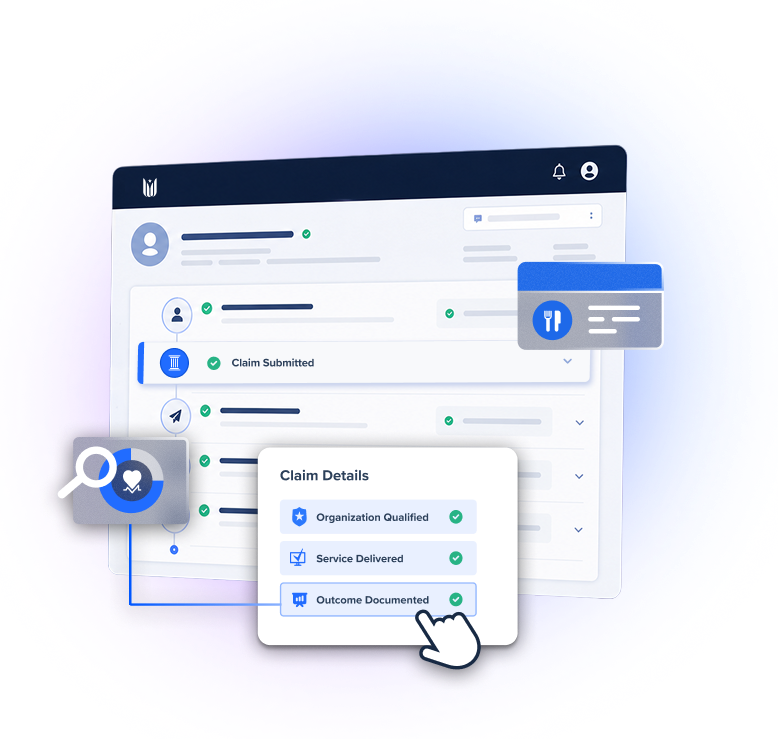
With Unite Us, every referral, case note, and payment lives in one secure, shared system, visible to both DJFS and community partner staff. That shift gave Summit County stronger safeguards against fraud, waste, and abuse:
- A single system of record for referrals and payments, replacing disconnected spreadsheets and email threads;
- Shared documentation between DJFS and community partners, so services and payments can be verified against actual case activity; and
- Clearer audit trails that support accountability and reduce the risk of duplicate or unsupported payments.
For a program distributing public funds to community partners, these added layers of accountability protect both participants and taxpayers.
Connecting Outcomes to a Bigger ROI
The original 2025 case study projected $21M in public-sector savings over 10 years. This follow-up evaluation puts that number at $43.7M, more than double the initial estimate.
The initial evaluation relied on conservative earnings estimates drawn from research on similar programs designed to support people through a benefits cliff. For this follow-up, Unite Us’ Research & Evaluation team had direct access to Summit County’s program data, including participants’ actual post-program earnings. Those earnings came in significantly higher than the original estimates, allowing for a more precise, more confident calculation of the program’s financial impact.
Participants’ median annual income increased by $12,000 by program exit. Projected forward, that increase generates an estimated $102,930 in public value per participant over the following decade, through reduced public benefit spending and increased tax revenue. Across 425 program exits, that’s $43.7M in cumulative public-sector savings.
$12,000
increase in median annual income by program exit
$102,930
estimated public value per participant over the following decade
$43.7M
in cumulative public-sector savings across 425 program exits
Lessons Learned
 Unified Technology Infrastructure Matters
Supporting economic mobility requires coordination across workforce agencies, healthcare providers, educational institutions, nonprofits, and other community partners. Without a shared system, referrals get tracked through disconnected emails, spreadsheets, and phone calls, making it difficult to know whether participants are actually connected with services or require additional support.
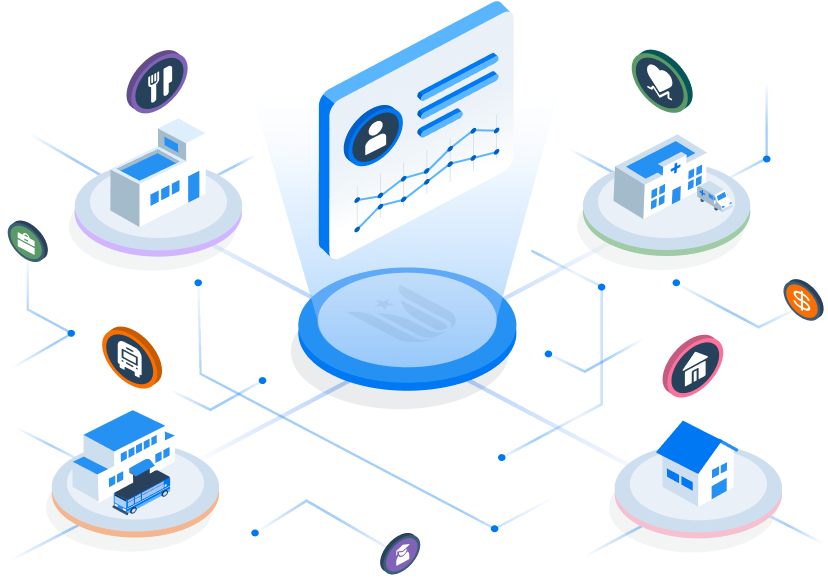
Unite Us provides the shared infrastructure that lets these organizations coordinate through closed-loop referrals, shared visibility into participant progress, and real-time communication.

“Previously, we were shifting around with SharePoints and Excel sheets and emails. Now [with Unite Us], it’s all in a one-stop-shop when it comes to being able to determine what’s going on for that member when it comes to provider engagement.”
— NEXT staff member
By giving providers a shared view of participant needs, referral outcomes, and payment activity, the platform reduces fragmentation, strengthens program integrity, and makes it easier for organizations to work together around the people they serve.
Coordinated Care Strengthens Whole-Person Workforce Development
Across the NEXT program, participants saw meaningful improvements in employment, financial stability, and reduced reliance on public assistance, a reflection of the strength of Summit County’s whole-person workforce development model.
Within that broader success, participants whose services were coordinated through Unite Us consistently showed stronger engagement and greater measured progress than participants who weren’t connected through the platform.
Technology alone doesn’t improve outcomes. But unified technology infrastructure can strengthen the delivery of whole-person services, helping organizations coordinate more effectively, engage participants more consistently, and connect people to the resources they need faster.
About Unite Us
Unite Us is the nation’s premier technology provider for integrating health and community-based care. Our proven product suite is used to proactively identify needs using advanced analytics, coordinate services between sectors in real-time, streamline referral and case management, and facilitate eligibility assessments and reimbursements across government, healthcare, health plans, and community organizations. The first of its kind, our closed-loop referral system prioritizes privacy and dignity and has integrated data and analytics tools used to measure impact, optimize programs, and shape policy. With over 2.1M services, we host the nation’s largest network of community-based health and economic services dedicated to improving whole-person health. Learn more at UniteUs.com and LinkedIn.