
Santa Fe CONNECT: A New Blueprint for Government-Led Community Care
Santa Fe CONNECT demonstrates how a government-led, technology-enabled approach can transform fragmented social and healthcare services into a coordinated system of community care. By collaborating with local partners to train and embed navigators across clinics, public agencies, and community-based organizations—and unifying them through a shared referral and care coordination platform powered by Unite Us—Santa Fe CONNECT created a single, accountable record of care for individuals seeking health and community services.

.
The Background: What is Santa Fe CONNECT?
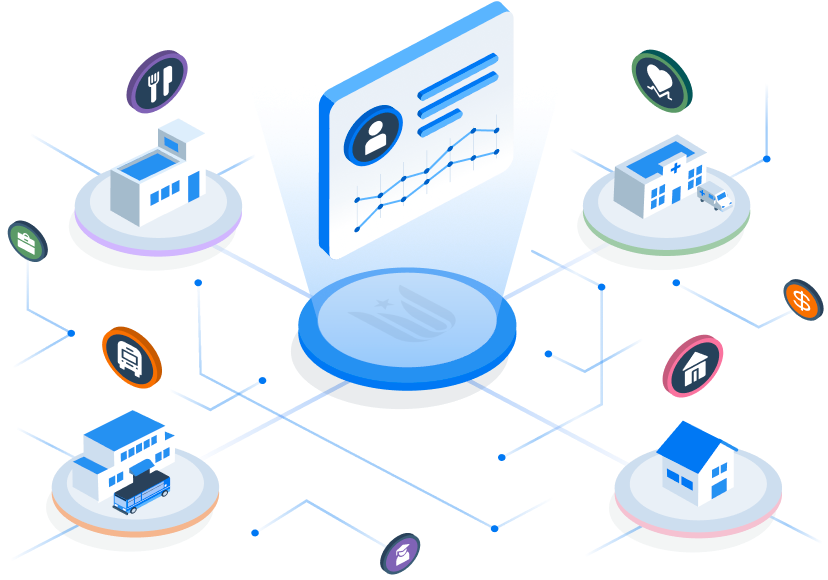
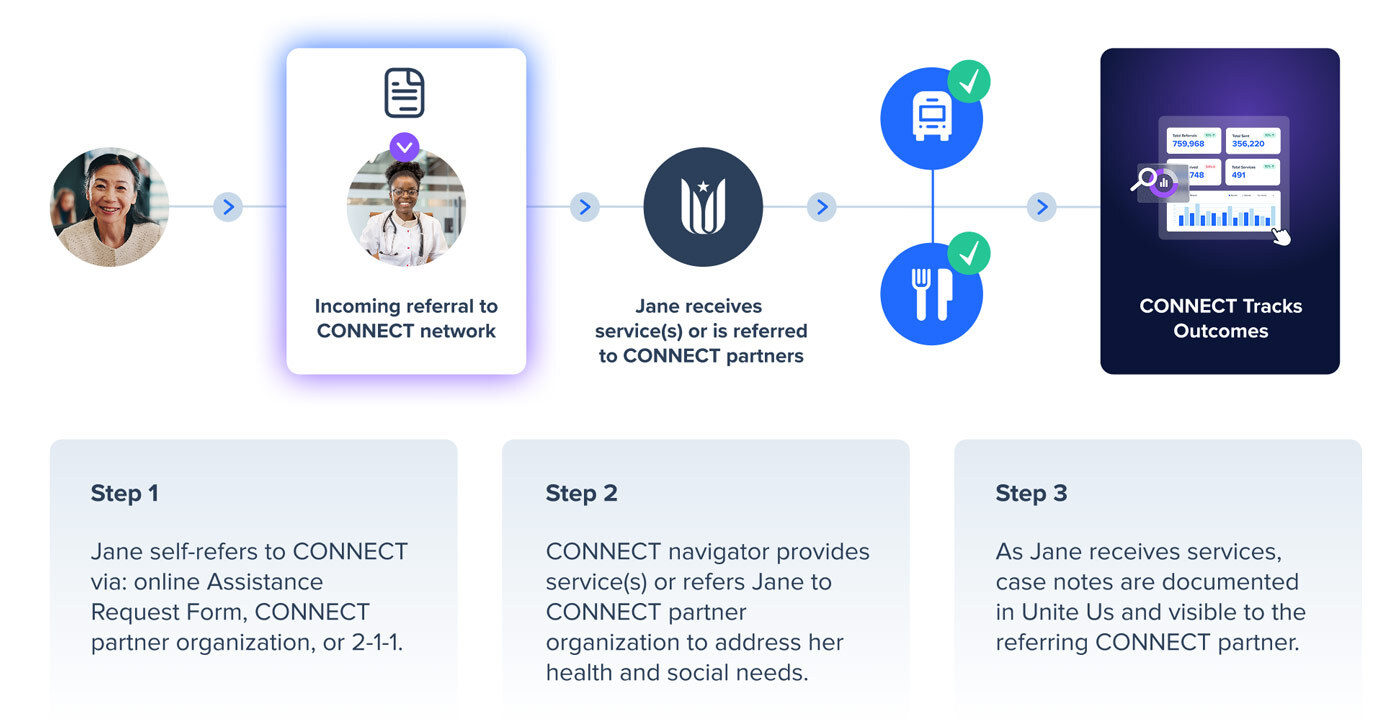
Santa Fe CONNECT is a joint partnership between Santa Fe County and the City of Santa Fe. CONNECT serves as a countywide care coordination and navigation network of trained navigators embedded in clinics, city and county programs, and community-based organizations. Navigators serve as care coordinators across the community, working directly with individuals to identify needs, initiate referrals, track progress in real time, and ensure follow-up across organizations.
Grounded in the Accountable Health Communities model, CONNECT addresses individuals’ unmet health and social needs—such as housing, food, income support, and access to public programs—by closing the gap between healthcare and community services.
By creating a shared system of care, CONNECT:
- Improves individual and community health outcomes;
- Enhances the quality and continuity of care; and
- Reduces avoidable healthcare utilization costs across the system.
The Challenge: Fragmented Care, Missed Opportunities
Prior to implementing Unite Us as the program’s technology infrastructure, CONNECT partner organizations relied on outdated, manual processes to coordinate care. Partners typically communicated through phone calls, faxes, and paper-based referrals—methods that were time-consuming, prone to error, and difficult to track. These inefficiencies often resulted in delayed care coordination, and a lack of real-time visibility into client progress across organizations.
The Solution: One Connected Record of Care
Recognizing the need for a more effective and accountable system, CONNECT integrated Unite Us’ platform into its existing workflows in 2019, creating a single, shared record of care across community programs. This transformation enabled real-time referral tracking, closed-loop communication, and shared accountability across the network.

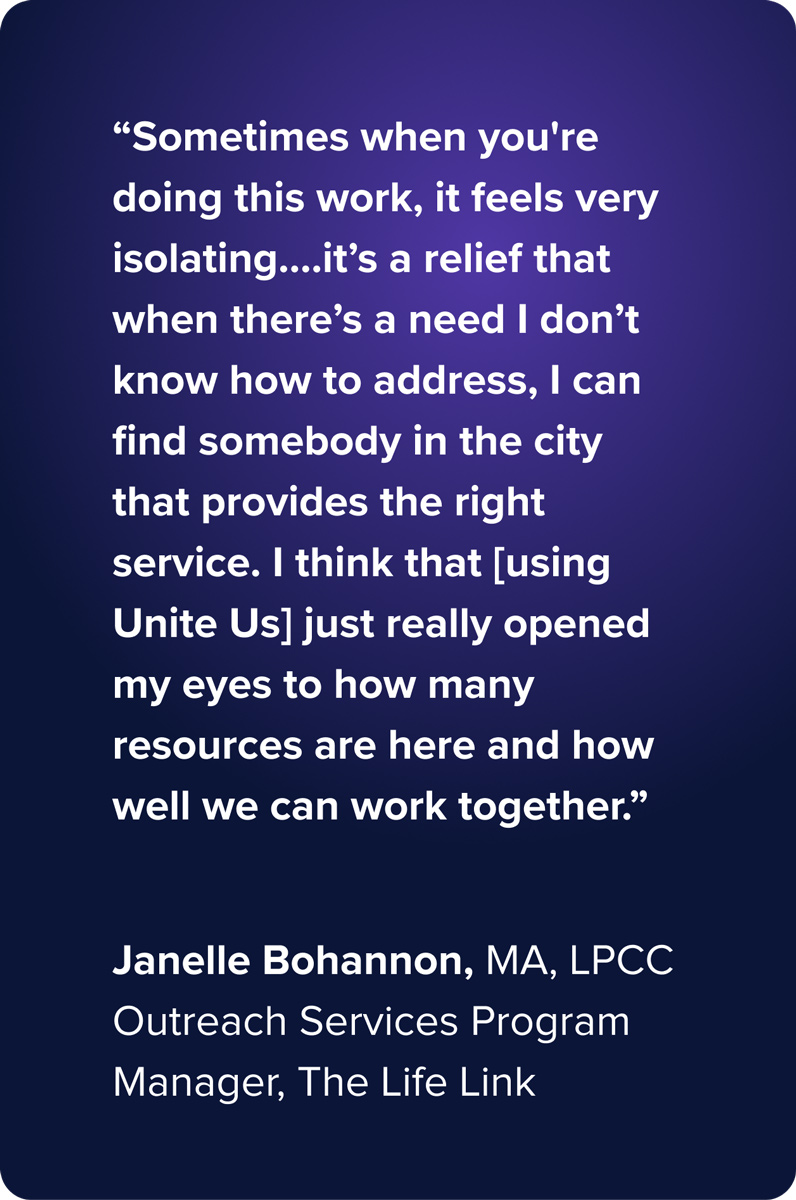
“We can see that our clients connected to the people we sent them to… there’s a level of accountability now that didn’t used to be there.”
– Janelle Bohannon, MA, LPCC, Outreach Services Program Manager, The Life Link
.
The Impact: Measurable Results, Real Lives Changed
Since utilizing Unite Us, Santa Fe CONNECT has delivered sustained, measurable impact:
 17,500+ referrals sent
- 13,092 individuals served
- Top identified needs:
- Housing & Shelter (24%)
- Income Support (22%)
- Individual & Family Support (21%)
- Food Assistance (8%)
- Benefits Navigation (7%)
*Data as of November 2025
.
Economic & Operational Impact
CONNECT has scaled to meet growing community needs, delivering outsized returns for individuals, providers, and taxpayers. To date, it is estimated that the program has saved up to $13.4 million in total cost of care,¹ improved efficiencies for frontline staff by generating over 3,200 saved administrative hours, and generated an estimated $19.7 million in household income by resolving unmet needs,² the cost of which would otherwise have been borne by individuals and their households in Santa Fe.

$13.4M Estimated Healthcare Cost Savings
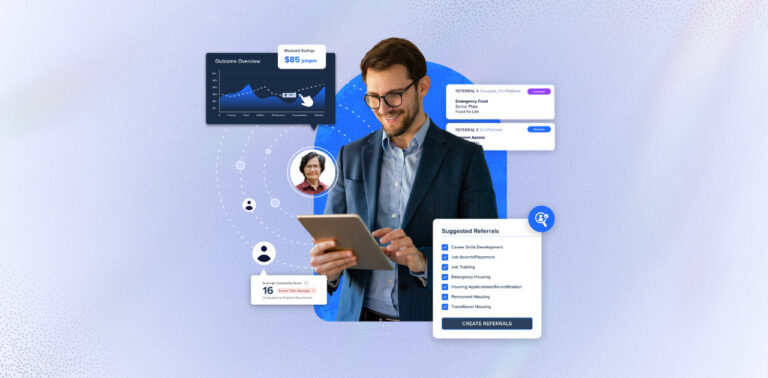
Based on North Carolina’s Healthy Opportunities Pilot (HOP) findings of $85 per member per month savings, applied to individuals receiving care coordination through CONNECT.

3,294 Admin Hours Saved
Average 13 minute time savings for each referred case based on a matched longitudinal survey of Unite Us end users.

$19.7M Generated Household Value
Estimated value of resolved needs (i.e. food, housing, transportation services provided) offsetting household income available to meet basic needs and improve quality of life.
The Power of the Network Effect
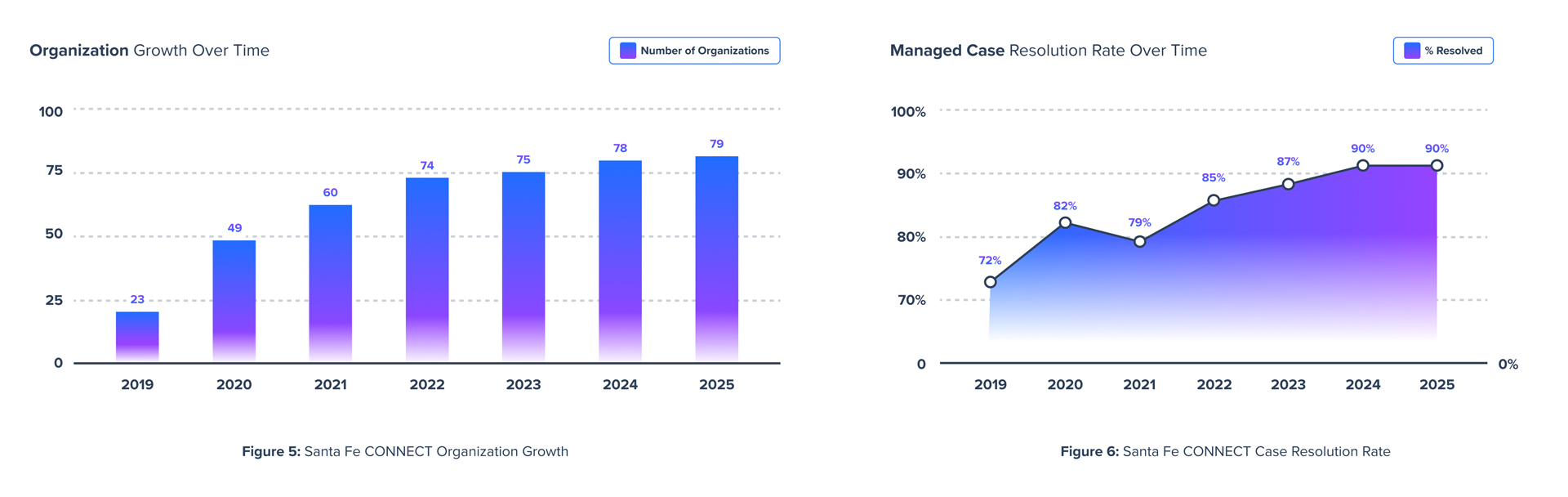
The CONNECT network has expanded significantly, now connecting individuals who reside in Santa Fe to 79 organizations. As a direct result of this increased collaboration, most referrals are accepted within just 1.5 days, and there has been clear, consistent improvement in case resolution rates over time. From 2019 to 2025, the percentage of managed cases that were resolved rose from 72% to 90%. While the total number of managed cases varied year to year, the overall resolution rate consistently increased, with 2024 and 2025 having resolution rates of 90%.
 CONNECT Hub – One Client’s Path to Self-Sufficiency
When Joe* first reached out for help, he was facing one of the most difficult moments of his life. After losing both his housing and job due to a medical condition, he found himself without a safe place to stay and unsure where to turn. Past experiences had left him distrustful of systems meant to support him.
Joe’s first point of contact was the CONNECT Hub. A Hub navigator met him with compassion and urgency, taking time to listen, build trust, and reassure him that he would not have to navigate his challenges alone. Recognizing his immediate need for safety, the navigator connected Joe to several organizations, including an emergency shelter—where he found a warm bed, meals, and a stable place to rest and recover.
Once Joe was safely housed, the CONNECT Hub navigator referred him to a partner organization who helped him access the medical care he had been unable to receive on his own. With proper treatment and medication, Joe’s physical and emotional health improved, giving him the strength to begin thinking about long-term goals.
As his stability increased, Joe continued working with CONNECT navigators across multiple partner organizations to pursue employment. With support in finding job resources, completing applications, and preparing for interviews, Joe soon secured a steady job aligned with his skills and regained financial independence.
Today, Joe is living on his own in stable housing, supporting himself, and thriving. What began as a moment of crisis became a path to self-sufficiency, made possible through coordinated, compassionate support.
*Name changed to protect client identity.
 The Cost of Inaction and the Opportunity Ahead
The CONNECT network has already shown what’s possible—connecting individuals to food, housing, and other supports that improve health and stability. Yet the opportunity to make an even greater impact is clear.
Today, one in seven individuals who reside in Santa Fe County—approximately 21,000 people—face food insecurity. If the CONNECT model reached every individual facing food insecurity in the county, it could not only reduce hunger but also realize an estimated $38.5 million in healthcare savings tied directly to food insecurity.
The potential impact is even greater for Medicaid beneficiaries. More than one in four individuals who reside in Santa Fe County rely on Medicaid (28%). If all of those individuals had their non-medical needs met through CONNECT, the community could experience transformative change—improved health outcomes, stronger families, and up to $45.4 million in healthcare savings, based on results from similar large-scale initiatives in other states.
Lessons Learned: Recommendations for Other Government Agencies
For other government organizations considering similar technology solutions, Santa Fe CONNECT recommends:
- Building a unified technology infrastructure to bring together municipalities and CBO partners in one platform with standardized workflows and training.
- Investing in upstream community-based interventions to scale programs that already show strong ROI in healthcare utilization savings and household income gains.
- Using real-time data to drive decisions and resource reallocation based on emerging needs and service gaps.
About Unite Us
Unite Us is the nation’s leading software company bringing sectors together to improve the health and well-being of communities. We drive the collaboration to identify, deliver, and pay for services that impact whole-person health. Through Unite Us’ national network and software, community-based organizations, government agencies, and healthcare organizations are all connected to better collaborate to meet the needs of the individuals in their communities.